Furoshiki: How to Wrap Gifts With a Japanese Cloth (Step by Step)
In short: A furoshiki (風呂敷) is a square cloth used in Japan for centuries to wrap and carry things. Today it’s popular again as reusable gift wrap: you can wrap almost any shape with a few knots, and the cloth becomes part of the gift. All you need to learn is one knot and three basic wraps.
What is furoshiki?
The word combines furo (bath) and shiki (to spread). A common explanation is that in the Edo period, people wrapped their clothes in a cloth at public bathhouses and stood on it while changing. Over time the same cloth became the everyday way to carry anything — lunch, books, shopping, gifts.
Plastic and paper bags replaced it in the 20th century, but furoshiki came back as an eco-friendly alternative. Japan’s Ministry of the Environment has promoted it as a way to reduce waste, and many shops in Japan now sell modern designs.
Koto’s tip: In Japan, a gift is traditionally carried in a furoshiki, and the cloth is unwrapped before handing the gift over — then the giver folds the cloth and takes it home. When you give a furoshiki-wrapped gift abroad, just say the cloth is part of the present!
Which size to choose
| Size (approx.) | Good for |
|---|---|
| 45–50 cm | Small boxes, lunch boxes (bento), a pouch for cosmetics |
| 70 cm | Books, a shoebox-sized gift, most everyday gifts — the most versatile size |
| 90–105 cm | Large boxes, two wine bottles, a carry-all bag |
| Larger | Blankets, cushions, moving things around the house |
Material: Cotton is easy to tie and wash, which makes it the best choice for beginners. Silk and rayon are beautiful for formal gifts but are more slippery. Polyester is light, strong and often water-resistant.
The basic knot: the square knot (ma-musubi)
Almost every wrap ends with this knot, which stays flat and neat and is easy to untie.
- Take two corners, one in each hand. Cross the right corner over the left and tie once (like the first step of tying shoelaces).
- Bring the ends back up. Now cross the corner that’s on the left over the right and tie again.
- Pull both ends evenly. The knot should lie flat, with the ends pointing sideways.
To untie: hold one end and pull it straight, so it becomes a straight line through the knot, then slide the knot off.
Koto’s tip: If the knot stands up instead of lying flat, you crossed the same way twice (a “granny knot”). Untie it and cross the opposite way on the second tie.
Wrap 1: The basic gift wrap (otsukai tsutsumi)
The classic way to wrap a box.
- Spread the cloth wrong side up, like a diamond, and put the box in the center.
- Fold the bottom corner over the box, and tuck any extra cloth under it.
- Fold the top corner over the box.
- Bring the left and right corners up and tie them on top with a square knot.
- Tidy the “ears” of the knot so they stand like a bow.
Wrap 2: Bottle wrap (bin tsutsumi)
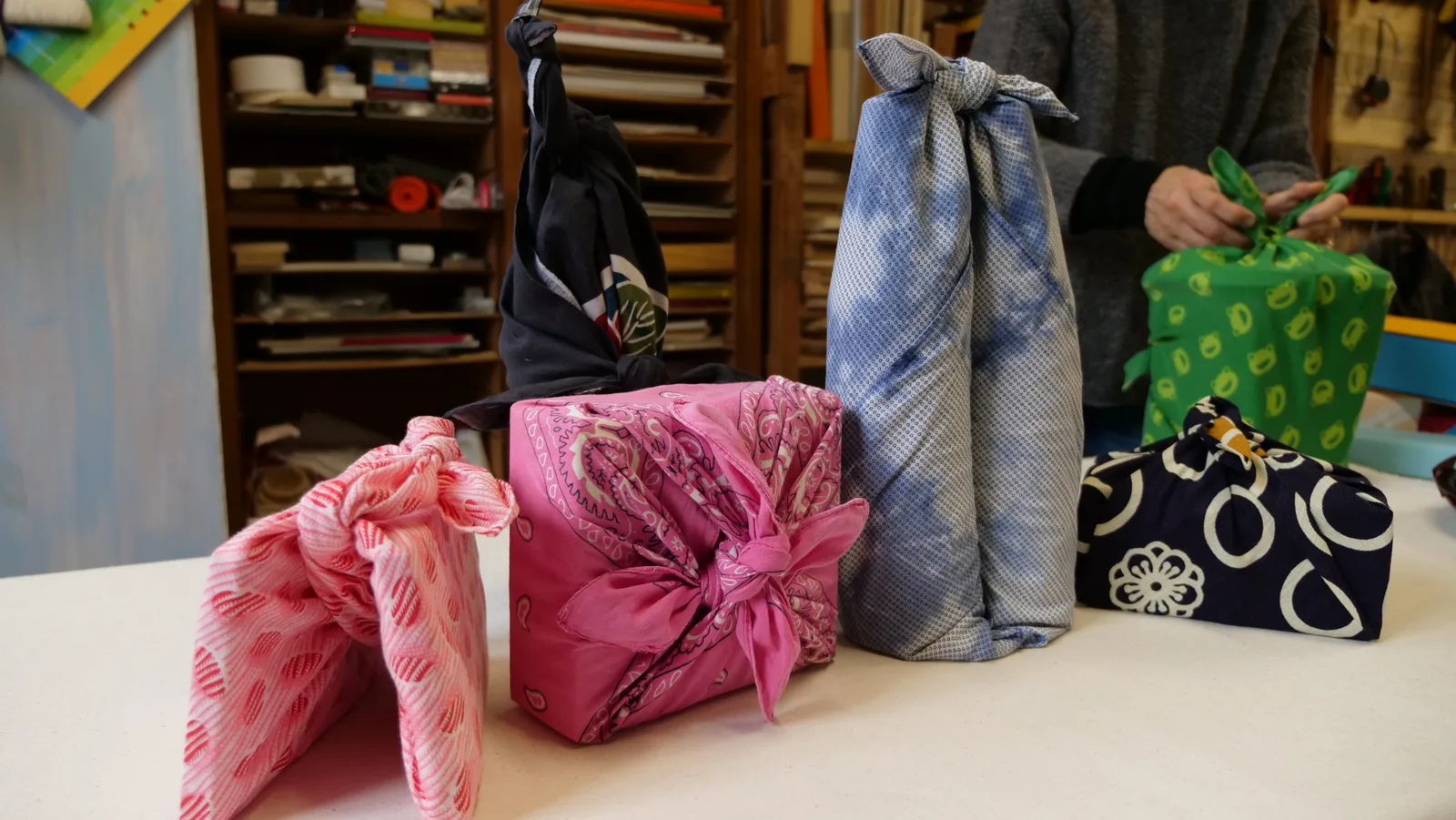
- Put the bottle in the center, standing up.
- Bring two opposite corners up and tie them in a square knot above the bottle’s neck.
- Wrap the other two corners around the bottle in opposite directions, cross them in front, and tie them in a square knot.
For two bottles, lay them end to end on the diagonal with a little space between, roll them up in the cloth, then stand them up and tie the two ends together — it makes a neat handle.
Wrap 3: Furoshiki bag
- Lay the cloth right side up and fold it in half into a triangle, with the fold at the bottom.
- Tie a small single knot at each of the two side points of the triangle — these become the bottom corners of the bag.
- Turn the bag inside out so the knots are hidden inside.
- Tie the two loose corners at the top together in a square knot to make a handle.
That’s it — a soft shopping bag that folds back into a square.
Wrapping tips
- Choose a cloth about three times the width of the box (measured across the diagonal of the cloth).
- Iron cotton before wrapping for crisp lines.
- Tuck in a card under the knot, or add a sprig of pine or a dried flower for the season.
- Patterns have meanings: cranes and pine for long life, waves (seigaiha) for calm and continuity, cherry blossoms for spring, hemp leaf (asanoha) for healthy growth.
FAQ
Can I use a scarf instead? Yes. Any square, not-too-slippery cloth works, but a real furoshiki is cut square and hemmed for tying.
How do I wash a furoshiki? Cotton and polyester can usually be hand-washed or machine-washed in a net bag. Dry flat. Silk needs gentle hand-washing or dry cleaning.
Is it okay to give the furoshiki as part of the gift? Absolutely — outside Japan, that’s the most common way, and the person gets a reusable wrap.
Related
Our picks
Cotton furoshiki (about 50–70 cm)
Easy to tie, washable and the right size for books, boxes and small gifts.
Best for: First furoshiki and gift wrapping
View at Amazon →Large furoshiki (about 90–105 cm)
Big enough for large boxes, two bottles, or to tie into a shopping bag.
Best for: Carrying and bigger gifts
View at Amazon →Tenugui cotton towel
A long, thin Japanese cloth that also works for wrapping bottles and small gifts.
Best for: A small extra gift
View at Amazon →