Japanese Kitchen Knives for Beginners: Santoku, Gyuto, Petty and More
In short: For most home cooks, the best first Japanese knife is a santoku (about 165–180 mm) or a gyuto (about 210 mm). Japanese knives are usually thinner and harder than Western ones, so they cut cleanly and stay sharp longer — but they need a little more care: no dishwasher, no bones, no twisting, and sharpening on a whetstone.
What makes Japanese knives different?
- Thin blades that glide through food with less force.
- Harder steel, which holds a very sharp edge for longer. The trade-off: hard edges can chip if used on bones, frozen food or glass cutting boards.
- A sharper edge angle than most Western knives.
- Lighter weight, so they feel quick and precise in the hand.
Japan has several famous knife-making towns, including Seki (Gifu), Sakai (Osaka), Tsubame-Sanjō (Niigata), Echizen (Fukui) and Tosa (Kōchi), many with traditions that go back to sword-making and blacksmithing.
The main types of Japanese knife
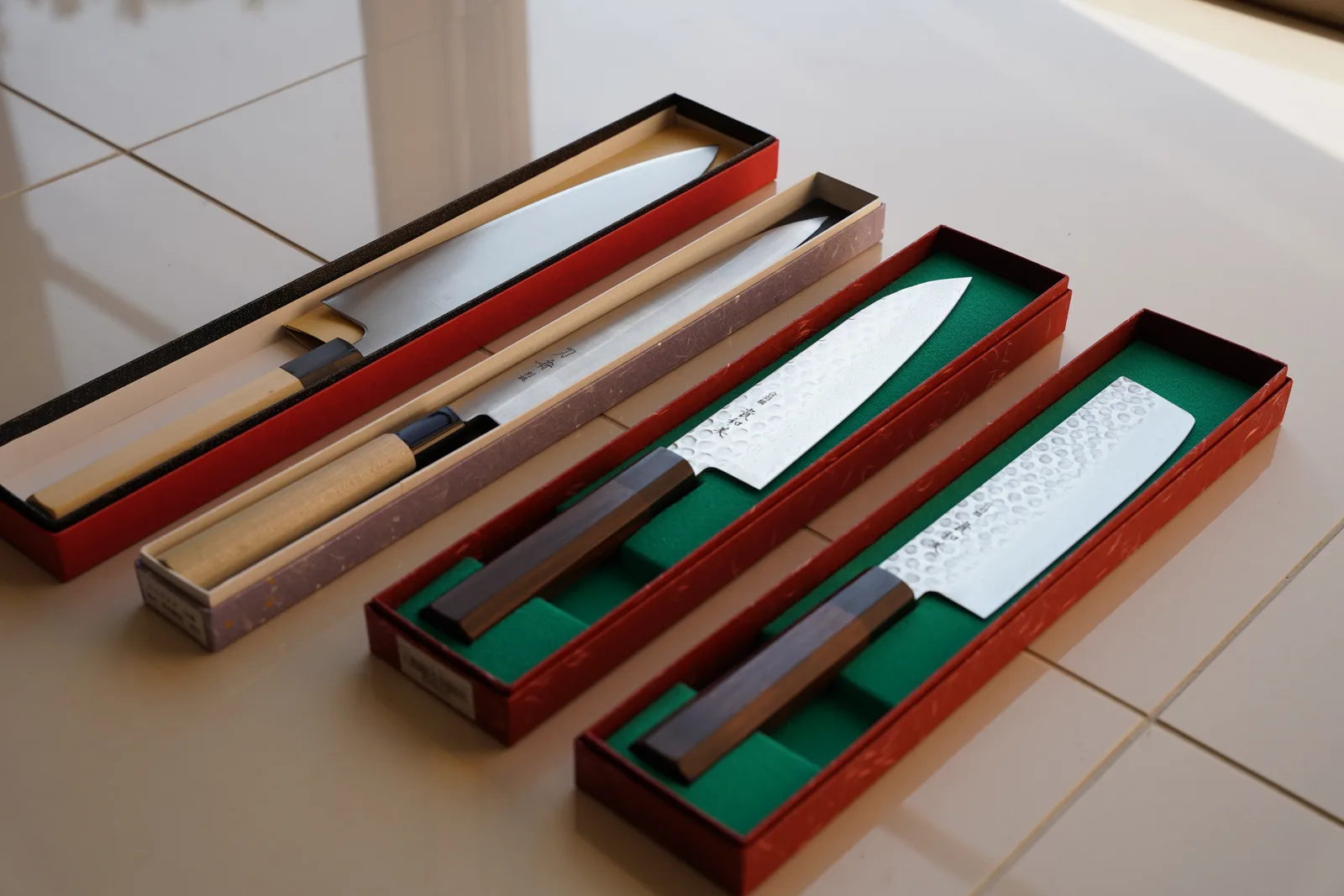
| Knife | Typical length (home use) | Best for | Good first knife? |
|---|---|---|---|
| Santoku (三徳) | 165–180 mm | Meat, fish and vegetables — “three virtues” | ✅ Yes |
| Gyuto (牛刀) | 210–240 mm | All-purpose chef’s knife, slicing, rocking | ✅ Yes |
| Petty (ペティ) | 120–150 mm | Fruit, herbs, small tasks | As a second knife |
| Nakiri (菜切り) | 160–180 mm | Vegetables — straight edge, chops cleanly | For vegetable lovers |
| Bunka (文化) | 165–180 mm | Like a santoku with a pointed tip | ✅ Yes |
| Deba (出刃) | 150–180 mm | Breaking down whole fish (thick, single bevel) | No — specialist |
| Yanagiba (柳刃) | 240–300 mm | Slicing raw fish for sashimi (single bevel) | No — specialist |
Santoku or gyuto?
- Choose a santoku if you have a small kitchen or cutting board, mostly chop vegetables, or want something easy to control.
- Choose a gyuto if you’re used to a Western chef’s knife, cook large amounts, or like the rocking motion with a pointed tip.
Koto’s tip: Hold the knife if you can. A knife that feels right in your hand is better than the “best” knife on paper. Many Japanese home cooks use one santoku for nearly everything!

Single bevel vs double bevel
Most Western-style Japanese knives (santoku, gyuto, petty, nakiri) are double bevel — sharpened on both sides — and work for right- and left-handed cooks.
Traditional knives like deba and yanagiba are single bevel: sharpened on one side only, for very precise cuts. They’re usually made for right-handed users, so left-handed cooks need to order a left-handed version.
Steel: stainless or carbon?
| Stainless steel (e.g. VG-10, AUS-10, Ginsan) | Carbon steel (e.g. Shirogami “white”, Aogami “blue”) | |
|---|---|---|
| Sharpness | Very sharp | Extremely sharp, easy to sharpen |
| Rust | Resists rust | Rusts if left wet; develops a patina |
| Care | Easier | Dry immediately after every use |
| Best for | Beginners and busy kitchens | Enthusiasts who enjoy maintenance |
Some knives have a carbon steel core clad in stainless steel — sharpness with easier care. Patterned “Damascus” blades are mostly about looks; the core steel matters more.
Handles
- Western (yo) handle: riveted, heavier, familiar if you’ve used European knives.
- Japanese (wa) handle: light wood, often octagonal or D-shaped, which makes the knife feel lighter and balanced toward the blade.
How to care for a Japanese knife
- Hand-wash and dry right away. Never put it in the dishwasher.
- Use a wood or soft plastic cutting board. Glass, stone and ceramic boards dull and chip the edge.
- Don’t cut bones, frozen food or very hard squash with a thin blade. Use a heavier knife for those jobs.
- Slice, don’t twist or pry. Sideways force is what chips hard edges.
- Store it safely on a magnetic strip, in a block or with a blade guard — not loose in a drawer.
How to sharpen (the basics)
Japanese knives are sharpened on whetstones. A two-sided stone with #1000 (for regular sharpening) and #3000–6000 (for polishing) covers most needs.
- Soak the stone in water for about 10 minutes if it’s a “soaking” stone (some stones only need a splash).
- Hold the blade at a low angle — about the height of two stacked coins under the spine.
- Push the edge across the stone in smooth strokes, working along the whole blade, then do the other side.
- Finish on the finer side, and wipe the knife clean.
Most home cooks sharpen every few weeks to few months. A honing rod made for hard steel (ceramic) can keep the edge straight between sharpenings, but avoid ridged steel rods on hard Japanese blades.
Koto’s tip: Many knife shops in Japan offer sharpening services, and so do knife shops abroad. If whetstones feel scary, start there.

FAQ
Are Japanese knives good for beginners? Yes, if you follow the care basics. A stainless santoku or gyuto is very forgiving.
Can I use a Japanese knife for meat? Yes — for boneless meat. Use a heavier knife or cleaver for bones.
Why did my knife chip? Usually from bones, frozen food, a hard cutting board, or twisting the blade. Small chips can be sharpened out.
Related
Our picks
Santoku knife (about 165–180 mm)
The classic Japanese home knife — meat, fish and vegetables in one blade, easy to control.
Best for: Your first Japanese knife
View at Amazon →Gyuto chef's knife (about 210 mm)
Longer, with a pointed tip for rocking and slicing — for people used to a Western chef's knife.
Best for: Cooks who prep a lot
View at Amazon →Petty knife (about 120–150 mm)
A small utility knife for fruit, herbs and fine work; a great second knife or a gift.
Best for: Small jobs and small kitchens
View at Amazon →Two-sided whetstone (#1000 / #6000)
One stone for regular sharpening and polishing — the way Japanese knives are meant to be kept sharp.
Best for: Keeping any knife sharp
View at Amazon →